
Honoring His Legacy and Reaffirming Our Commitment to Continuing the Enlightenment Project
His life left us no room for complacency. – Indira Haider Ibrahim
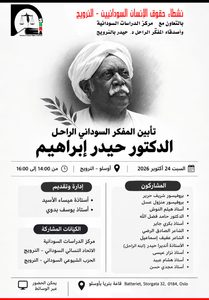
Sudanese Human Rights Activists – Norway organized a memorial event for the late Sudanese thinker Dr. Haider Ibrahim Ali at the PATRIA Foundation’s premises in Oslo.
The two-and-a-half-hour gathering was hosted by organization members Ms. Maysaa Al-Sayed and Mr. Yousif Badawi Abdelrahman. The event was distinguished by the diversity of contributions and the sincerity of the words shared by participants, including the late thinker’s daughter, Ms. Indira Haider, and his wife, Ms. Hayat Obeid.
Below are the main highlights of the participants’ contributions, together with the starting time of each presentation.
We apologize to those who were not notified of the change to the event link during the final day before the gathering. We also extend our apologies to attendees who were unable to participate due to time constraints.
We must work to enlighten our societies. – Sharif Harir
Professor Sharif Harir
Professor Harir, a politician and former researcher at the Chr. Michelsen Institute in Bergen, opened the presentations by recounting what he described as “Haider’s miracles.” He shared several moving recollections of the late thinker from the period when they worked together at the University of Gezira.
He added that Dr. Haider’s intellectual engagement with the Frankfurt School, Herbert Marcuse, and other thinkers associated with that tradition, particularly the importance of the public sphere, inspired him to establish the Sudanese Studies Center. Without the Center, many writings would never have seen the light of day.
Why aren’t people like Dr. Haider governing us? – Haitham Al-Noush
Mr. Haitham Al-Noush
Mr. Al-Noush, who works at the Norwegian Agency for Development Cooperation (Norad) and spoke on behalf of Sudanese Human Rights Activists, focused on the important role Dr. Haider’s writings played in promoting enlightenment and building democratic awareness.
He asked: “Why aren’t people like Dr. Haider governing us?”
Al-Noush proposed establishing an annual intellectual event in Dr. Haider Ibrahim’s name to discuss his works.
Mr. Nizar Issa
Mr. Nizar Issa, representing the Sudanese Communist Party in Norway, reviewed the late thinker’s contributions to research, publishing, and resistance to authoritarianism.
He also highlighted the role of the journal Sudanese Writings (Kitabat Sudaniya) in providing a platform for researchers and creative thinkers.
Equal citizenship is not a position against religion, and recognizing diversity does not require abandoning one’s beliefs. – Munzoul Assal
Professor Munzoul Assal
Professor Assal, Professor of Social Anthropology at the University of Bergen, connected Dr. Haider’s intellectual legacy with Sudan’s current challenges, including war, citizenship, the relationship between religion and the state, and the responsibility of the country’s elites.
He called for a critical reassessment of Sudan’s history, the question of Sudan’s delayed renaissance, and the reasons behind the failures of its institutions.
Professor Assal also discussed the intellectual foundations of Haider Ibrahim’s project, emphasizing their importance and the need to engage with his works through both appreciation and critical examination.
Dr. Hamed Fadlallah
Dr. Hamed Fadlallah, a physician and writer participating from Berlin, presented a comprehensive paper on Dr. Haider’s life and the activities of the Sudanese Studies Center from the 1990s until his return to Khartoum.
He recalled Dr. Haider’s determination to continue research and dialogue despite restrictions and exile.
Poet Al-Sadiq Al-Raddi
Poet Al-Sadiq Al-Raddi offered an elegant poetic contribution to the memorial.
Despite the obstacles, the work of enlightenment will continue. – Bakri Jaber
Mr. Bakri Jaber
Mr. Bakri Jaber of the Sudanese Studies Center focused on explaining the Center’s development through its different stages and the various projects it has undertaken.
He emphasized that the work of enlightenment would continue despite the obstacles, foremost among them the confiscation of the Center’s premises, which had been allocated to it through former Prime Minister Abdalla Hamdok.
He called for support for the project and its expansion.
Ms. Indira Haider
The contribution of the late thinker’s daughter was thoughtful and deeply moving.
She described her father, Dr. Haider, as a man who lived simply and remained true to his principles, qualities she considered central to his character.
She offered a profound reflection: “His life left us no room for complacency.”
Her words called for transforming grief into energy for action and constructive work, and for continuing his faith in young people.
Dr. Haider lives on as long as enlightenment lives on. – Hayat Obeid
Mrs. Hayat Obeid
The late thinker’s wife delivered a brief address in which she expressed her gratitude for the memorial gathering.
She added that Dr. Haider lives on as long as enlightenment lives on, and recalled several projects he had intended to undertake but did not live to complete.
I propose an annual conference on his birthday. – Afif Ismail
Poet Afif Ismail
Participating from Australia, poet Afif Ismail spoke about his experiences with Dr. Haider and what he had learned from him regarding intellectual independence, discipline, and the importance of commitment in the life of an intellectual.
His contribution also included poetry readings honoring the late thinker.
He proposed holding an annual conference to mark Dr. Haider’s birthday and called for collecting his manuscripts, photographs, and personal belongings, while supporting the continued work of the Center and its journal.
Ms. Mayssa Al-Esayid
Ms. Maysaa Al-Sayed, representing the Sudanese Women’s Union – Norway, highlighted Dr. Haider’s support for women’s causes, his understanding of women’s liberation as inseparable from the liberation of society and democracy, and his commitment to resisting the political and cultural marginalization of Sudanese women.
Mr. Hisham Obeid
Mr. Hisham Obeid presented a poetic contribution exploring sacrifice, loss, and homeland, reflecting on the contributions of intellectuals and creative figures and calling for an end to war and destruction.
Mr. Magdi Hassan
Mr. Magdi Hassan offered a reading of the book Times of Wind, Anxiety, and Freedom (Azminat al-Rih wa al-Qalaq wa al-Hurriya).
His contribution reflected on gratitude for life, inner contentment, and the commitment to freedom. He emphasized the importance of translating intellectual questions into practice and building a culture that embraces differences while preserving the humanity and dignity of those who hold different views.
We must continue his project of awareness and enlightenment. – Yousif Badawi
Closing Remarks
Mr. Yousif concluded the gathering by thanking the speakers and attendees and renewing the call to continue Dr. Haider’s project of promoting awareness and enlightenment, working to end the war, and realizing the Sudanese people’s aspirations for peace and freedom.